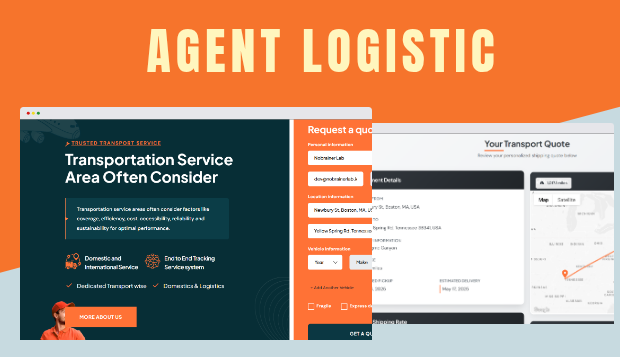
Agent Logistics is a comprehensive logistics management system built for transportation and delivery companies, enabling efficient coordination of shipments, tracking of cargo, and management of delivery personnel. Developed with PHP Symfony framework and integrated API architecture, this application streamlines logistics operations from order intake to final delivery.
Project Overview
Agent Logistics provides logistics companies with a robust, enterprise-grade solution to manage their entire operational workflow. The application serves as a central command center where administrators, dispatchers, drivers, and clients can access appropriate information and functionality through role-based interfaces tailored to their specific needs.
The platform offers end-to-end visibility of the logistics pipeline, from initial order placement through routing, assignment, transportation, and final delivery. Real-time tracking capabilities allow all stakeholders to monitor shipment status, while automated notifications keep clients informed at every step of the delivery process.
Key features include order management with custom workflow support, intelligent route optimization, driver assignment and scheduling, vehicle fleet management, real-time GPS tracking integration, electronic proof of delivery, invoicing, and comprehensive reporting. The system also provides client-facing portals where customers can place orders, track shipments, and access delivery documentation.
Agent Logistics stands out through its flexibility and scalability, accommodating various logistics models from small courier services to large-scale freight operations. The robust API architecture enables seamless integration with existing business systems such as ERP, CRM, accounting software, and third-party services including mapping platforms and payment processors.
Whether managing local deliveries or international shipping operations, Agent Logistics provides the technological infrastructure to optimize resource allocation, reduce operational costs, maintain compliance with regulations, and deliver exceptional service to clients.
The Approach & Solution
The development of Agent Logistics followed an enterprise architecture approach that prioritized reliability, scalability, and integration capabilities. The technical implementation leveraged the following technologies and methodologies:
PHP Symfony Framework: The application core was built using Symfony, a mature PHP framework known for its robustness in enterprise applications. Symfony's component-based architecture provided a solid foundation for developing a modular system that could be extended as business requirements evolved.
Twig Templating Engine: The frontend views were implemented using Twig, Symfony's templating engine, enabling clean separation of presentation logic from business logic while maintaining high performance. Twig templates facilitated the creation of consistent user interfaces across different sections of the application.
JavaScript Enhancement: The user experience was enriched with JavaScript to create dynamic, responsive interfaces where appropriate. This included interactive dashboards for dispatchers, real-time updates for tracking information, and form validations for data entry.
API-First Design: The system was architected with a comprehensive API layer that served both internal components and external integrations. This API-first approach provided:
RESTful endpoints for client applications and mobile interfaces
Integration points for third-party services like mapping and payment systems
Webhooks for event-driven architecture with partner systems
Documentation using OpenAPI specifications for developer onboarding
Database Optimization: The data model was carefully designed to balance normalization with query performance, implementing appropriate indexing strategies, and utilizing caching mechanisms to handle high transaction volumes typical in logistics operations.
Security Implementation: Given the sensitive nature of logistics data (including client information and valuable cargo details), the system incorporated multiple security layers:
Role-based access control with fine-grained permissions
Data encryption for sensitive information
Secure API authentication using OAuth 2.0
Comprehensive audit logging for all system activities
Containerized Deployment: The application was configured for deployment using Docker containers, ensuring consistency across development, testing, and production environments while facilitating horizontal scaling during peak demand periods.
Automated Testing Suite: A comprehensive testing strategy was implemented with:
Unit tests for business logic validation
Integration tests for API endpoints
Functional tests for critical user workflows
Continuous Integration pipeline for automated quality control
This development approach resulted in a robust, scalable logistics management system that could adapt to changing business requirements while maintaining performance and reliability under the demands of real-world logistics operations.
